
Guide
How to get better at Brazilian Jiu Jitsu faster
You get better at Brazilian Jiu Jitsu faster by attending regularly, concentrating on a small number of positions, drilling with purpose, sparring to learn rather than to win, and staying healthy enough to keep training. There is no shortcut around time on the mat, but there are plenty of ways to waste it.
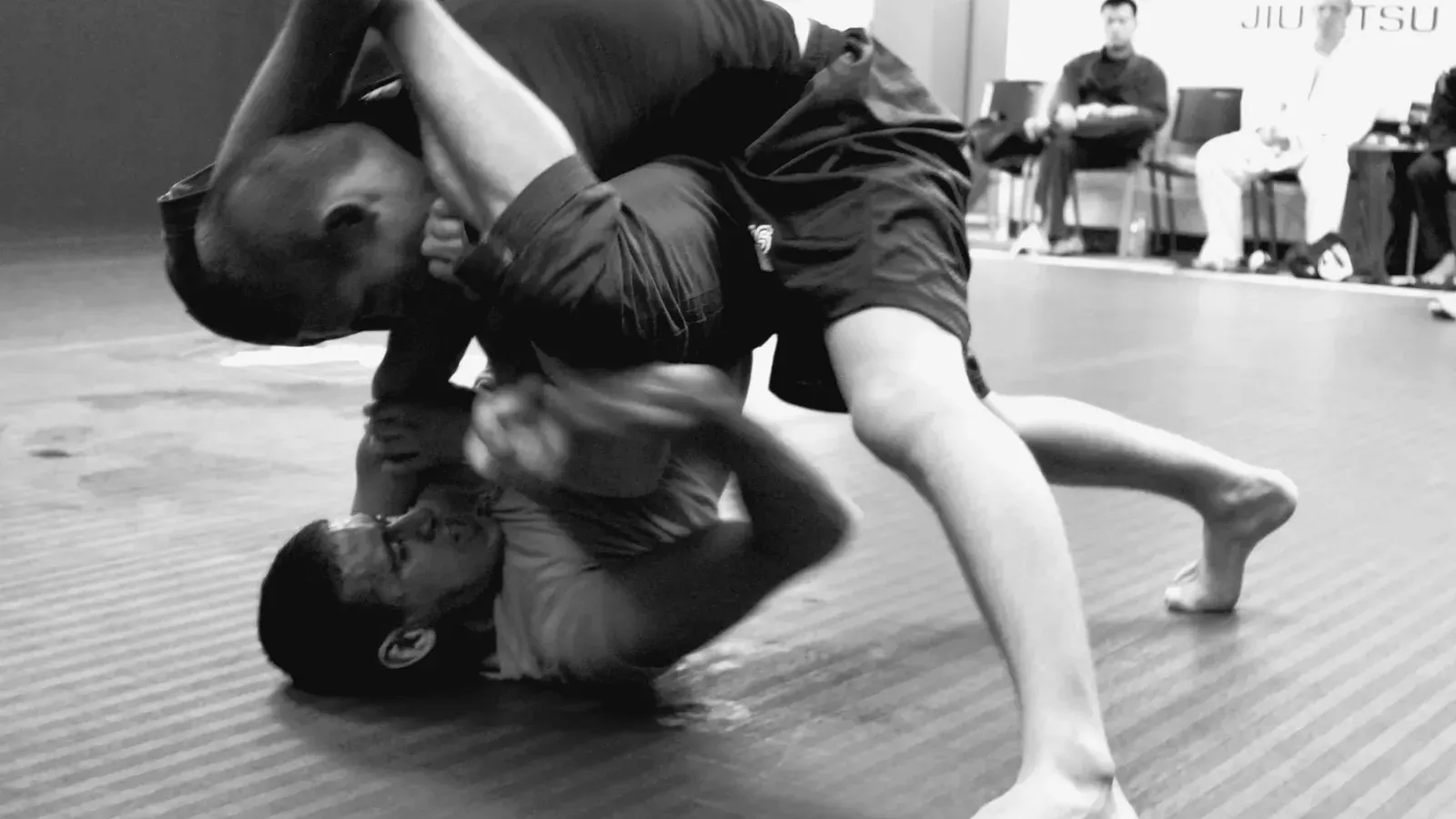
Mark Bonica from Durham, NH, USA · Wikimedia Commons · CC BY 2.0
.jpg)
You get better at Brazilian Jiu Jitsu faster by turning up regularly, narrowing your focus to a few positions, drilling them with a clear purpose, sparring to learn rather than to win, and reviewing what happened afterwards. Nothing replaces time on the mat. What you can control is how much of that time turns into skill.
Train regularly before you train more
Consistency matters more than the occasional heavy week. Two or three sessions every week, sustained over months, will teach you more than a burst of daily training that ends in injury or burnout.
Pick a schedule you can keep through a busy month, not one that only works in a good one. If you miss a week, you lose some of the timing and retention you built, so a steady rhythm protects your progress.
Choose a few positions and stay with them
Beginners often try to collect techniques. A better approach is to collect positions: a small set of places you know well, such as closed guard, side control and mount, and how to escape from each.
Decide on one or two priorities at a time. For example, you might spend a month working on getting out from underneath side control. Learn the basic escapes, and make them the first thing you reach for when you land there in sparring. Once they start to work, add the next priority.
This keeps you from having a thin, disconnected knowledge of forty techniques and a habit of panicking in the positions you meet most.
Drill with a purpose
Drilling means repeating a technique or sequence with a partner who gives you a controlled amount of resistance. Its value depends on how you do it.
Start slowly and with full attention to the details your coach showed you: where your hips are, where your grips are, and where your partner’s weight sits. Only add speed once the movement is accurate. Then ask your partner to add resistance in stages, so the technique has to work against a person who is reacting.
Mindless repetition builds sloppy habits. Ten careful repetitions with a specific question in mind, such as “where does my elbow go here?”, are worth more than a hundred distracted ones.
Use positional sparring
Positional sparring is sparring that begins from a set position, with each person given a specific job. One person might try to escape from side control while the other tries to hold it. When someone succeeds, you reset and go again.
It is one of the fastest ways to improve because you meet the same problem many times in a session. In ordinary sparring you might reach a given position twice in a round. Here you reach it every thirty seconds or so.
Ask your coach or training partners to set these up, and use them for the positions you chose to work on.
Spar to learn, not to win
Sparring, often called rolling, is where you find out what actually works against a resisting person. It is also where ego does the most damage to progress.
If you treat every round as a contest, you will lean on strength, avoid positions you are weak in and stop experimenting. Progress often comes from the opposite: starting rounds in bad positions on purpose, trying the technique you drilled that week even though it might fail, and accepting that being caught is information.
Roll with a range of partners. Smaller, larger, newer and more experienced people each pose different problems and teach you different things. With a much more experienced partner, your aim is to survive well and notice what they do. With a newer one, your aim is to stay relaxed and practise control.
Control is also a matter of safety. Apply submissions slowly, stop the moment your partner taps or calls out, and tap early yourself. A partner you injure cannot train with you, and an injury to you costs you far more training time than a lost round.
Review what happened
After each session, take a few minutes to write down what you were caught in, what you managed to do, and one question to ask your coach. Over a few weeks the same entries will keep showing up, and those are your real priorities.
Do not rely on memory alone. Sessions blur together, and the useful detail from a Tuesday class is usually gone by Friday.
If your gym permits it, filming a round can show you things you cannot feel while you are in it, such as where your posture collapses or when you stop moving.
Look after your body
Recovery is part of training. Sleep, eating enough and taking rest days let you get through the next session at a useful quality.
Do not train through sharp pain or a joint that feels unstable. Tell your coach about an injury so they can suggest what you can safely do. Working around a minor problem is usually possible, and it is better than a layoff of weeks.
Get the most from classes and open mats
A structured class gives you a curriculum and a coach’s corrections. If you are new, a fundamentals class is designed to cover the basic positions in a sensible order, which suits the position-first approach above.
An open mat is unstructured mat time. It is useful once you know what you want to work on, because you can spend the whole session on your chosen positions with willing partners.
Training at home can support this, but it cannot replace a partner who resists. If you want to know what is realistic, see how to learn Brazilian Jiu Jitsu at home.
When this applies and when it does not
This approach applies to almost anybody training regularly with a coach and partners. It matters most in the early stages, when the gap between focused and unfocused training is widest.
It applies less well in three situations. If you can only train once a week, the advice on consistency and recovery matters less than making that session count, so focus on one or two positions and note what you learn. If you are injured, the priority is a sensible return, not speed. And if you compete, your preparation will follow the rules of your event and the plan your coach sets, which may differ from the general advice here.
If you have not yet started, what to expect from your first class covers the practical starting point, and how to learn Brazilian Jiu Jitsu gives the wider picture.
What people get wrong
The most common mistake is collecting techniques instead of building a game around a handful of positions. A large repertoire you cannot use under pressure is not much help.
The second is muscling. Strength can win rounds against people who are less strong, but it hides errors in position and timing. The habits it produces tend to stop working against someone of equal size and better technique.
The third is treating sparring as the only training. Rolling every day without drilling or reflection tends to repeat the same mistakes. Skill improves when you test what you have practised and then adjust.
The fourth is comparing your progress to other people’s. People start with different bodies, backgrounds and amounts of free time. Measure yourself against your own rounds from a month ago. If you are escaping positions you used to be stuck in, you are improving.
The last is training through injuries out of impatience. It usually costs more time than it saves.