
Guide
Brazilian Jiu Jitsu Submissions From Knee on Belly
Knee on belly is a dominant ground position where a bent knee pins the opponent's torso, offering a direct route to the armbar and a compression submission when the opponent reacts by pushing or exposing their torso. More often it serves as a staging point into stronger finishing positions such as north-south or mount, where further chokes and joint locks become available.
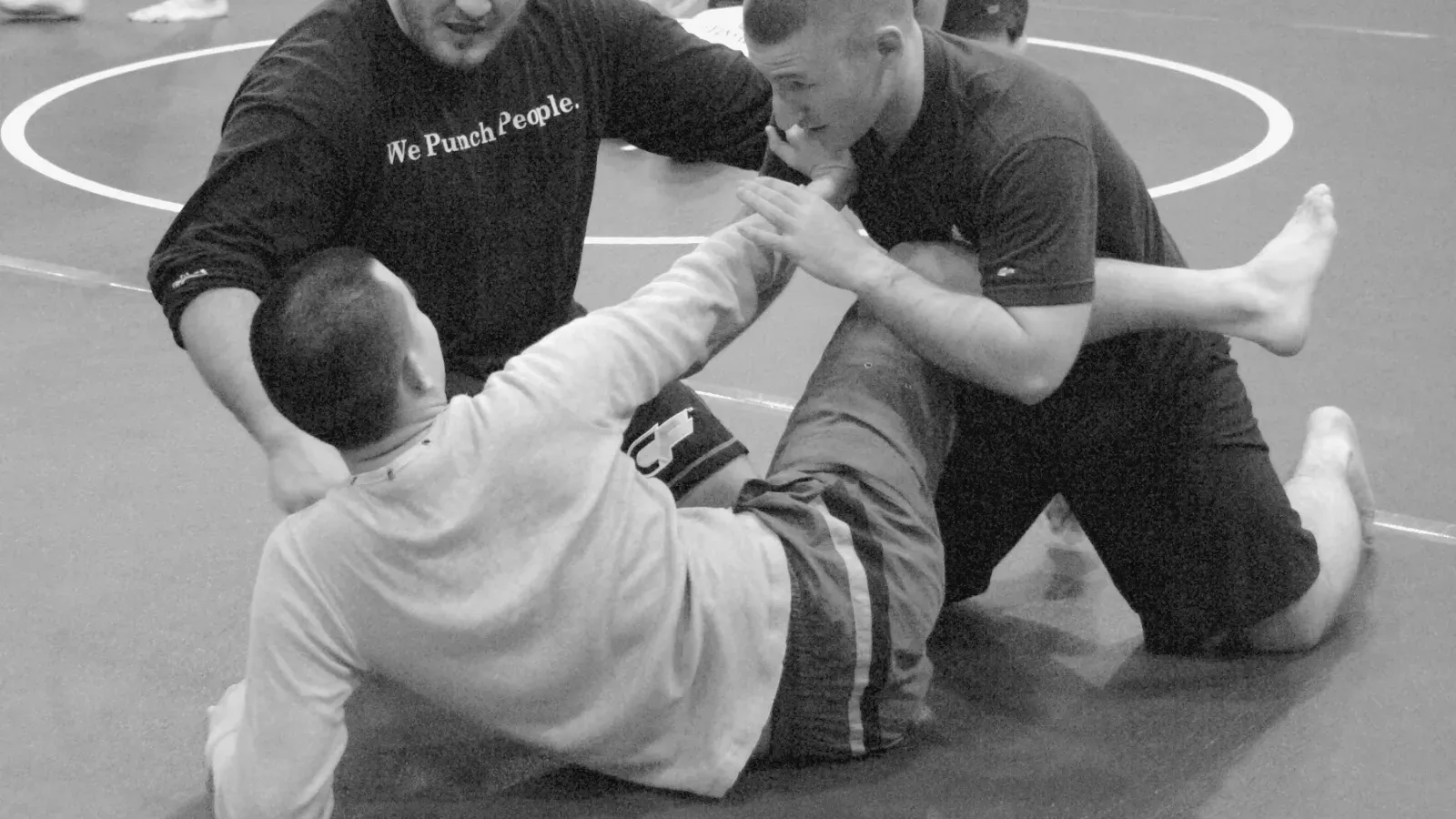
Knee on belly rarely finishes a fight on its own. It is a dominant pressure position from which two submissions are directly available, and a route into stronger finishing positions such as north-south and mount, where further chokes and joint locks become live.
What knee on belly is
Knee-on-belly, also known as knee ride, knee-on-stomach or knee-on-chest, is a dominant ground grappling position where you place one knee on your opponent’s torso and extend your other leg out to the side for balance. It is a modified side pin, distinct from side control itself. You typically arrive here from side control, rising up slightly and dropping a knee onto the opponent’s stomach or chest rather than keeping your weight spread across their body.
That change in weight distribution is what makes the position useful. Because your weight bears down through one knee instead of across the whole torso, knee-on-belly gives you a wider striking platform than side control and moves you closer to the more stable control of mount, the position where you sit fully astride the opponent’s torso. The trade-off is stability. Knee-on-belly is not as secure as mount, so it functions best as a stop on the way to something firmer. You can transition into various holds or other positions from here, and disengage or escape easily if your opponent threatens a sweep.
When it leads to a submission directly
Two submissions are available without moving off the position itself.
The first is the straight armlock, known by its judo name juji-gatame. If your opponent pushes on you with a straight arm to try to create space or shove you off, you can capture that arm and finish the armbar. The opponent creates the opening by straightening the limb against your weight, and you are isolating what they offer rather than forcing it. This is the same joint exposure at work when the armbar comes from side control: control the elbow, keep the extension along the joint’s natural line, and release the moment your opponent taps, since forcing the lock past resistance risks the elbow rather than just causing discomfort.
The second is compression. Your knee and body weight already bear down on the opponent’s torso, and you can sometimes finish simply by increasing that pressure until it becomes painful or, if it restricts the breath, causes compressive asphyxia, meaning the opponent submits because the weight on their chest makes breathing difficult rather than because a joint or blood vessel is under direct attack. This only works as a genuine submission when the opponent can tap to release it, so keep the pressure adjustable rather than sudden. It is worth remembering that the most common injuries in Brazilian Jiu Jitsu overall are ACL tears, rotator cuff tears, and spinal disc herniation in the neck, which is reason enough to control the pace of any finish rather than rushing it.
Submissions on the way through
Most of the time, knee-on-belly is a passing point rather than a finishing one. Two directions open from here.
Climb further over the opponent’s head and you arrive at north-south, where you lie across the opponent with your weight over their chest and head and your legs pointing away from them. North-south carries its own submissions and transitions, most commonly the north-south choke and the north-south kimura, along with several others.
Settle back down instead, and you are moving toward mount, where the same armbar principle applies: an arm that straightens against your weight becomes available to attack, which is the sequencing covered in How to armbar from mount.
Gi and no-gi differences
Some of what becomes available from knee-on-belly and the positions it leads to depends on whether you are competing in the gi. A number of submissions, such as the collar choke, exist only because the gi’s fabric gives you something to grip. No-gi Brazilian Jiu Jitsu allows no such collar and runs under its own subset of rules, so finishes reached through these transitional positions rely on the neck and limbs instead of cloth.
What knee-on-belly does not give you is a route to leg locks. The position controls the torso, not the legs, so the joint locks available from it run through the arm and neck rather than the knee or ankle. That distinction matters because leg attack rules vary sharply by ruleset: heel hooks and knee-reaping are banned in gi Brazilian Jiu Jitsu but allowed in no-gi competition under IBJJF rules, and most competitions restrict joint locks that twist the knee regardless of the gi, since a completed heel hook can cause damage that needs surgery. None of that applies to knee-on-belly directly, since there is no leg to attack from this position in the first place.
What people get wrong
The most common error is treating knee-on-belly as a hold to sit in, the way mount can be held while you work a submission. It is less stable than mount, so staying there too long without progressing gives the opponent time to bridge or shrimp free, and you lose the position rather than finish it. Use it to advance toward mount or north-south, or to finish quickly, not to camp on it.
The second error is expecting the armbar to appear on demand. It only becomes available if the opponent pushes on you with a straight arm. Grabbing for a defended, bent limb from here is not the same submission and is far less likely to succeed. If the opponent keeps their arms bent and tucked, the more productive move is to advance the position rather than force a lock that is not there.
A third error is chasing leg locks from knee-on-belly. Since the position pins the torso rather than the legs, there is no leg on offer here, and reaching for one usually means giving up the pressure you already have for no submission at all.