
Guide
What Is Stacking in Brazilian Jiu Jitsu?
Stacking is a guard pass in which the passer lifts the opponent and stacks them while inside the opponent's open guard, which can lead to a neck crank or blood choke. This guide explains where it applies, where it does not, and the common mistakes in how people understand it.
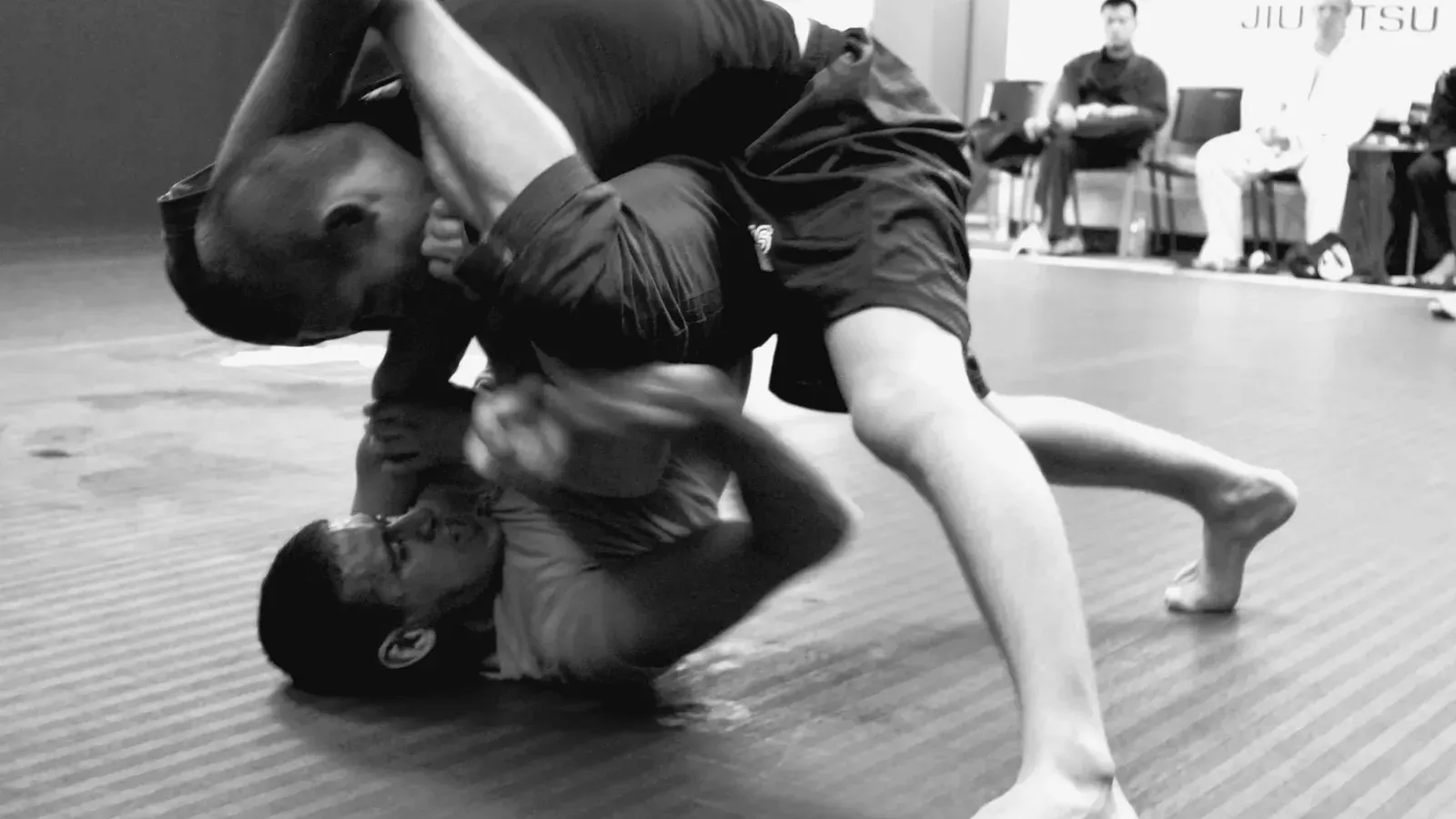
Mark Bonica from Durham, NH, USA · Wikimedia Commons · CC BY 2.0
.jpg)
Stacking is a guard pass. You are in your opponent’s open guard, you lift them and stack them, and that can lead into a possible neck crank or blood choke. That lifting and stacking is the main characteristic of the technique. The rest of this guide explains what that means in practice, where it fits and where it does not.
What stacking means
The guard is a ground position in which one person lies with their back on the mat and tries to control the other using their legs. The person on top is trying to get past those legs and into a more dominant position. That process is called passing the guard.
Stacking is one way of doing it. Instead of walking around the legs, you lift the person on the bottom and stack them, so their body is folded and their weight is put onto their upper body. The position it produces can open the way to a neck crank or a blood choke.
A neck crank is a hold that applies pressure to the neck by pulling or twisting the head. A blood choke is a chokehold, a type of submission hold, that works on the neck rather than on the airway. In both cases the submission is a possible consequence of the stack. The stack itself is the pass.
The technique is not unique to Brazilian Jiu Jitsu. The stacking guard pass appears in a judo book, The Essence Of Judo, and an unnamed technique of the same kind is described in another, The Canon Of Judo.
When stacking applies
The description of stacking places it in the opponent’s open guard. Open guard is a general term for the many guard positions in which the bottom person’s legs push, wrap or hook you without the ankles being locked around you.
That suits the technique. In open guard the bottom person is not clamping you in place, so you have room to get underneath them and lift. The open guard also lets the opponent stand up or try to pass, and it is often used only temporarily to set up sweeps or other techniques. A stack can therefore meet a guard that is already in transition.
So you can expect stacking to be relevant when three things are true:
- You are on top, inside the opponent’s legs.
- The opponent’s legs are not locked around your back.
- You can lift their weight and fold them rather than merely pressing on them.
When stacking does not apply
Stacking is a poor fit for the closed guard. In closed guard the bottom person’s legs are hooked behind your back, which stops you from standing up or moving away. That control works against the lifting that stacking needs, so the sensible first job there is to open the guard.
It also does not apply when the position is not a guard at all. If you are already past the legs, there is nothing left to pass, and a stack is not the tool. Nor does it describe positions such as half guard, where the guard player has wrapped both legs around one of your legs. The description of stacking refers to open guard, and this guide stays within that.
What people get wrong
Treating stacking as a submission
The most common mistake is to file stacking alongside chokes and armlocks. It is a pass. A neck crank or blood choke may become available from it, but the defining act is lifting and stacking the opponent while you are in their open guard. If no submission follows, the pass can still be complete.
Treating it as a general-purpose pass
The technique belongs to a specific situation, the opponent’s open guard. Trying it against a closed guard, or in a position where you cannot lift the opponent, means you are attempting a different pass under the wrong name.
Treating the neck as a target for force
Neck cranks and chokes are submission holds, and submission holds are applied to force an opponent to submit through extreme pain or fear of injury. Used incorrectly, holds of this type can cause serious injury, including dislocation, torn ligaments, fractures and unconsciousness. The neck deserves particular care because the position of a stacked opponent already puts their head and upper body under load.
If you drill stacking, do it with control and at slow speed, and stop the moment your partner taps or signals. Check the rules of your academy or event before you go for a neck crank in sparring or competition, as rulesets differ on what they allow.
Confusing the name with an unrelated technique
Because the word is used loosely, people sometimes apply it to any pressure that folds an opponent. The supported meaning here is narrower: lifting the opponent and stacking them from inside open guard, as a guard pass with a possible neck crank or blood choke attached.