
Guide
What Is S-Mount in Brazilian Jiu Jitsu?
S-mount is one of the recognised variations of the mount position in Brazilian Jiu Jitsu, alongside low-mount, mid-mount, high-mount and technical mount. It only becomes available once the bottom grappler's guard, including half guard, has been fully passed.
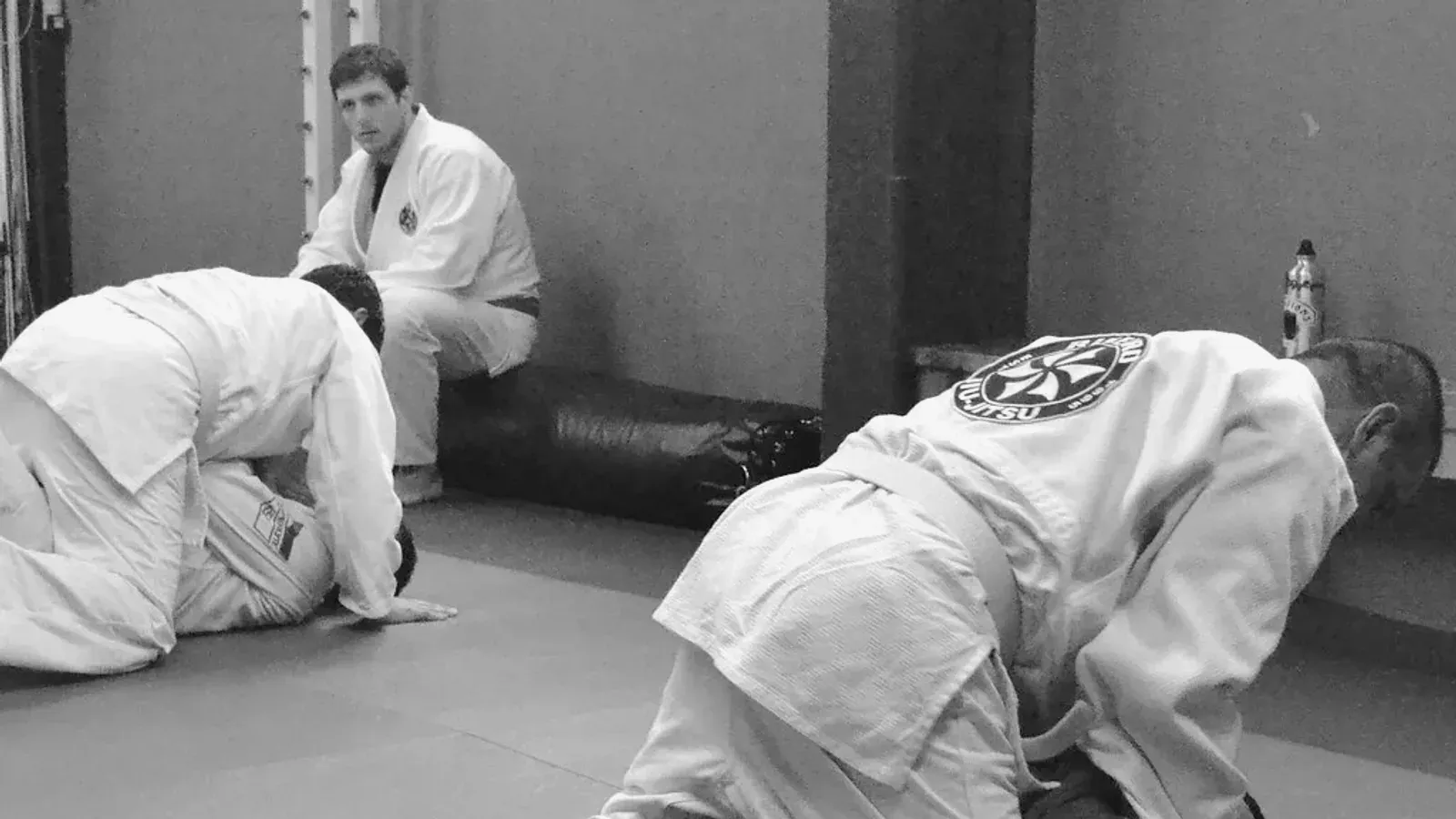
Ippon.Kumite · Openverse (flickr) · Creative Commons Attribution 2.0
What S-mount is
S-mount is one of the recognised variations of the mount position in Brazilian Jiu Jitsu, a grappling-based combat sport in which the aim is to establish a dominant position on the ground and finish the opponent with a chokehold or joint lock. Mount is not a single fixed position: it covers several distinct body positions, and S-mount is one of them, alongside low-mount, mid-mount, high-mount and technical mount. S-mount describes a particular way of holding the mount rather than a position separate from it.
Because it is a form of mount, S-mount carries the same status within Brazilian Jiu Jitsu as the rest of the mount family: it is one of the dominant ground positions the sport is built around, where the aim is to control an opponent closely enough to work towards a chokehold or joint lock.
Where S-mount sits in the hierarchy of positions
Brazilian Jiu Jitsu ranks ground positions by how much control they give the grappler on top. Side control and knee-on-belly sit below mount and rear mount in that hierarchy. Knee-on-belly, for instance, is worth additional points because it gives the top grappler a greater platform to work from than side control and is closer to achieving the more ideal mounted position. Mount and rear mount sit further up again: positions such as rear mount receive a higher score than the positions that lead into them, reflecting how much control they give the grappler holding them.
S-mount, as a variant of mount, belongs at this upper end of the hierarchy. It is not a stepping stone towards mount in the way knee-on-belly is a stepping stone towards it; it is one of the recognised forms mount itself can take once achieved.
What has to happen before S-mount applies
Mount, in any of its variants, depends on the top grappler having already passed the bottom grappler’s guard. Guard is the position in which the bottom grappler, lying on their back, uses their legs to control the grappler on top; from guard the bottom grappler can attack with joint locks and chokeholds of their own, while the top grappler’s task is to work past the legs into a more dominant position such as side control or mount. Until guard is passed, none of the mount variants, including S-mount, are available to the top grappler.
Half guard shows one of the ways this passing can be prevented. In half guard, the bottom grappler’s legs control one of the top grappler’s legs, which stops the top grappler from passing into side control or full mount. While half guard holds, S-mount and the other mount variants stay out of reach, regardless of how much pressure or positioning the top grappler otherwise has.
When S-mount does not apply
S-mount, like the rest of the mount family, applies only once guard has been fully passed and no partial leg control, such as half guard, remains. It does not apply while the bottom grappler retains any form of guard, and it does not exist as a position on its own outside of mount - it is a way of sitting within mount, not an alternative to it. If a grappler is still working through an opponent’s open guard or half guard, none of the mount variants, S-mount included, describe what is happening at that moment.
What people get wrong about S-mount
The most common mistake is treating S-mount as a stand-alone position, disconnected from mount itself. It is not. It is one of several recognised ways of holding mount, sitting alongside low-mount, mid-mount, high-mount and technical mount as a variation defined by body positioning rather than as its own category of position.
The second mistake is assuming that any dominant top position, once reached, is functionally the same as any other. Brazilian Jiu Jitsu scores positions differently precisely because they offer different levels of control: knee-on-belly is valued above side control for the platform it gives, and rear mount above that again. S-mount’s value comes from where it sits within this same hierarchy, as a form of mount, not from being a separate or higher-ranked position of its own.
The third is underestimating what has to be overcome before the position becomes available. Half guard exists specifically because it denies the top grappler the leg control needed to reach side control or mount. Treating S-mount as something that can be reached without first dealing with guard, or partial guard such as half guard, misreads where the position sits in the sequence of a fight.