
Guide
No Gi Brazilian Jiu Jitsu in San Diego: What It Is and How to Find It
No gi Brazilian Jiu Jitsu is Brazilian Jiu Jitsu trained and competed without the gi, and San Diego has some of the best-known academies in the sport for it. This guide explains when the term applies, when it does not, and the common misunderstandings people bring to a first class.
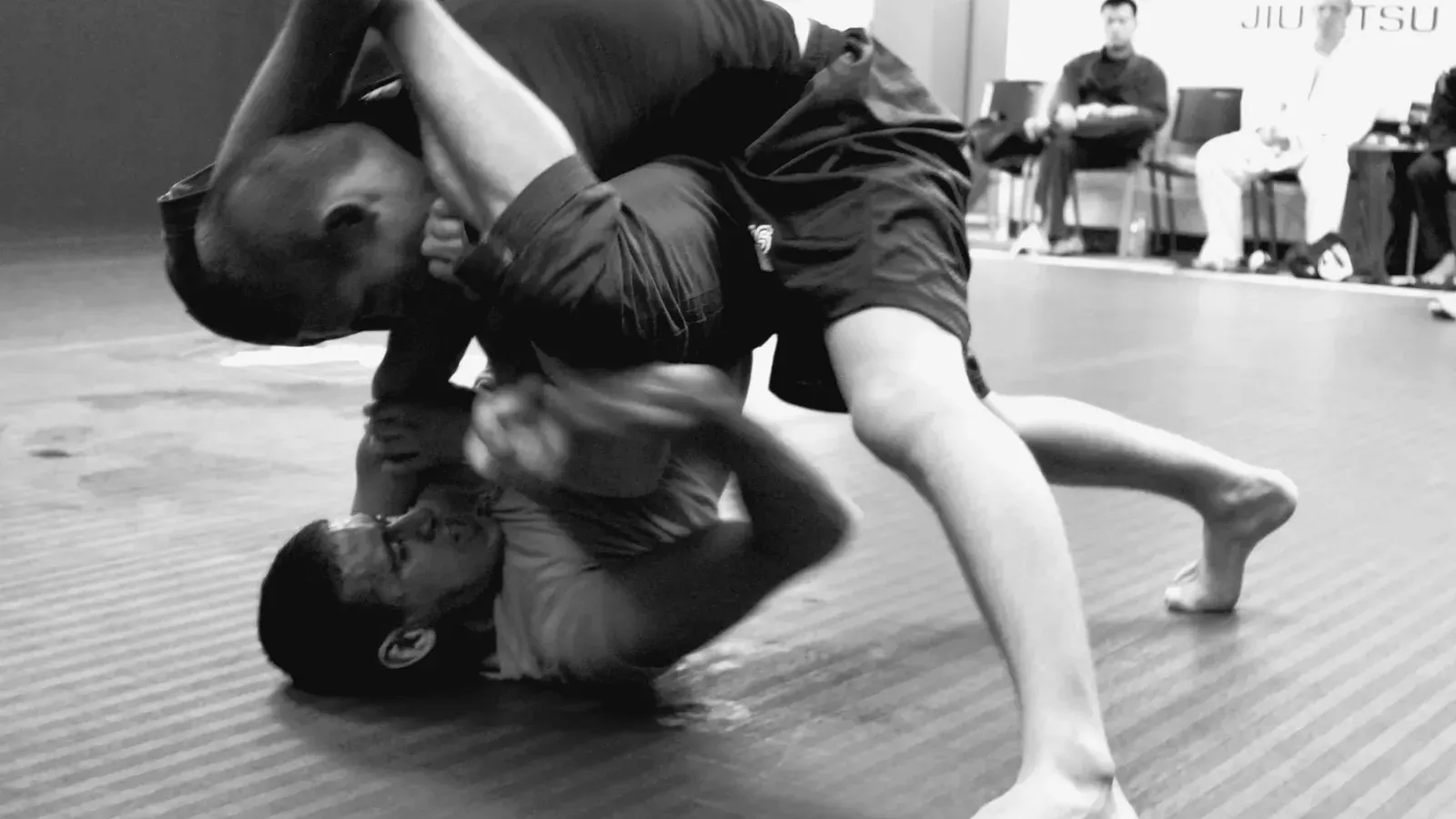
Mark Bonica from Durham, NH, USA · Wikimedia Commons · CC BY 2.0
.jpg)
No gi Brazilian Jiu Jitsu is Brazilian Jiu Jitsu practised without the gi, the heavy jacket and trousers sometimes called a combat kimono. You still work for positional control, joint locks and chokes, but you cannot grip fabric. If you are searching for it in San Diego, you are looking for an academy that runs no gi classes as a distinct part of its timetable, not just an occasional open mat.
What no gi means
The term “no-gi” usually refers to a form of training and competition that does not use the gi. Brazilian Jiu Jitsu is trained both with and without it, so no gi is not a separate martial art. It is one way of practising the same one.
The practical difference is grips. In the gi you can hold collars, sleeves and trousers. Without it, you control an opponent through body contact, underhooks, overhooks, wrist control and head position. Exchanges are often faster, because there is less fabric to slow a partner down.
When the term applies
The phrase applies when the aim is to win or train by submission or positional control, without a gi. That covers three common situations.
Classes at an academy
Many academies run gi and no gi sessions side by side. Atos Jiu-Jitsu is a Brazilian Jiu Jitsu academy and competition team that has been headquartered in San Diego, California, since 2010, and its headquarters is recognised as one of the premier Brazilian Jiu Jitsu training facilities in the world. Its published description lists both gi and no gi classes. Timetables change, so confirm current no gi sessions with any academy before you visit.
Competition
The International Brazilian Jiu-Jitsu Federation (IBJJF) is a for-profit company that hosts several of the largest tournaments in the sport. These include the World No-Gi Championship. The IBJJF uses the ruleset of the Confederação Brasileira de Jiu-Jitsu, its sister organisation in Brazil. If you plan to compete, check the rules of the specific event you enter, because no gi rulesets vary between organisers.
Submission grappling and wrestling
No gi Brazilian Jiu Jitsu is often used as a synonym for submission wrestling in some circles. Submission wrestling, also called submission grappling or simply grappling, is a combat sport built around ground fighting and submission techniques. It draws on wrestling styles, judo and Brazilian Jiu Jitsu. Brazilian Jiu Jitsu without the gi is described as the primary art from which modern submission wrestling practice derives.
When it does not apply
The label stops fitting in a few cases.
- Gi classes. If the session is in the gi, it is not no gi, however similar the positions look.
- Striking arts. Mixed martial arts and other striking-based sports involve more than grappling. Grappling ability is a major part of mixed martial arts, and many people train no gi partly for that reason, but a no gi Brazilian Jiu Jitsu class is not an MMA class.
- Other grappling arts. Judo, sambo, catch wrestling and freestyle wrestling are related but distinct. Some are also trained without a gi, yet they have their own rules and emphasis.
- Hybrid systems. Some styles are American hybrids of no gi Brazilian Jiu Jitsu with influences from folkstyle wrestling, and they give particular attention to no gi half guard and to guard techniques that may be considered unorthodox in Brazilian Jiu Jitsu. Ask what a class teaches before assuming it matches a standard Brazilian Jiu Jitsu curriculum.
What people get wrong
“No gi is a different sport”
It is not. It is the same art, with the same core aim of controlling a partner and finishing with a submission. What changes is how you grip and how fast the exchanges tend to run.
“No gi is the same as submission wrestling”
It is often treated as a synonym, but submission wrestling is a broader label that some schools and fighters use to avoid association with any one martial art. Rulesets in the wider field also differ. Some competitions allow strikes, while others are grappling only. A class advertised as no gi Brazilian Jiu Jitsu is normally grappling only, but confirm this with the academy if it matters to you.
“No gi is easier because there is less to learn”
Losing the gi removes one set of grips and adds a different set of problems. Without fabric to hold, a partner is harder to pin and easier to slip away from. Your control has to come from positioning rather than grips, and that takes time to build.
“Ranks work the same everywhere in grappling”
Submission wrestling does not follow a universal ranking structure. Brazilian Jiu Jitsu uses a coloured belt system to show experience and progression, while other grappling styles, such as catch wrestling, place more emphasis on competition results and practical skill. Ask an academy how it grades no gi students, since belts may be awarded within the same system as the gi.
“Any San Diego academy with Brazilian Jiu Jitsu will do”
An academy that lists Brazilian Jiu Jitsu may teach mostly in the gi. Look for a no gi class on the timetable, and ask whether it is suitable for beginners. A famous name does not guarantee a beginner-friendly session at the time you can attend.
Choosing a class in San Diego
A few practical checks will tell you more than a website slogan.
- Confirm that the class you want is no gi, and that it runs at a time you can attend regularly.
- Ask whether it is a fundamentals session or an advanced or competition class.
- Ask about live sparring, often called rolling, and how the coach manages it for newcomers.
- Check what to wear. No gi training generally means fitted athletic clothing without zips, hard fastenings or pockets, but each academy sets its own rules.
Training structure varies. Most sessions combine drilling techniques, live sparring and conditioning. Drilling is repeating a technique cooperatively until it is reliable, and rolling is sparring at a chosen intensity.
Safety in no gi training
Submissions are the point of the sport, so safety depends on control and communication. Grapplers are taught to recognise dangerous positions and to submit before serious injury occurs. Submitting is usually done by tapping, which means striking your partner or the mat, or by saying so aloud. Whoever applies a joint lock or choke must apply it progressively and release the moment a partner taps.
No gi adds one extra consideration. Without a jacket to grip, a partner can slip out of a hold suddenly, so a sloppy submission attempt can become a jerking one. Control the position first and finish slowly. In competition, referees may stop a match if a competitor cannot defend themselves or is in immediate danger.
Where the label runs out
The phrase covers a lot of ground, from a Tuesday evening class to a world championship. What it does not tell you is the quality of a particular session, its level or its rules. Those you have to ask the academy directly, which is the only reliable way to know what you are walking into.