
Guide
Is Gi or No-Gi More Realistic?
Gi and no-gi Brazilian Jiu Jitsu are both sporting formats with defined rules, so neither can be verified as flatly more realistic than the other for unarmed combat. The clearest evidence available concerns how individual techniques, such as the rear naked choke, change once the gi is removed, and how mixed martial arts, fought mostly without a gi, still operates under codified rules rather than open combat.
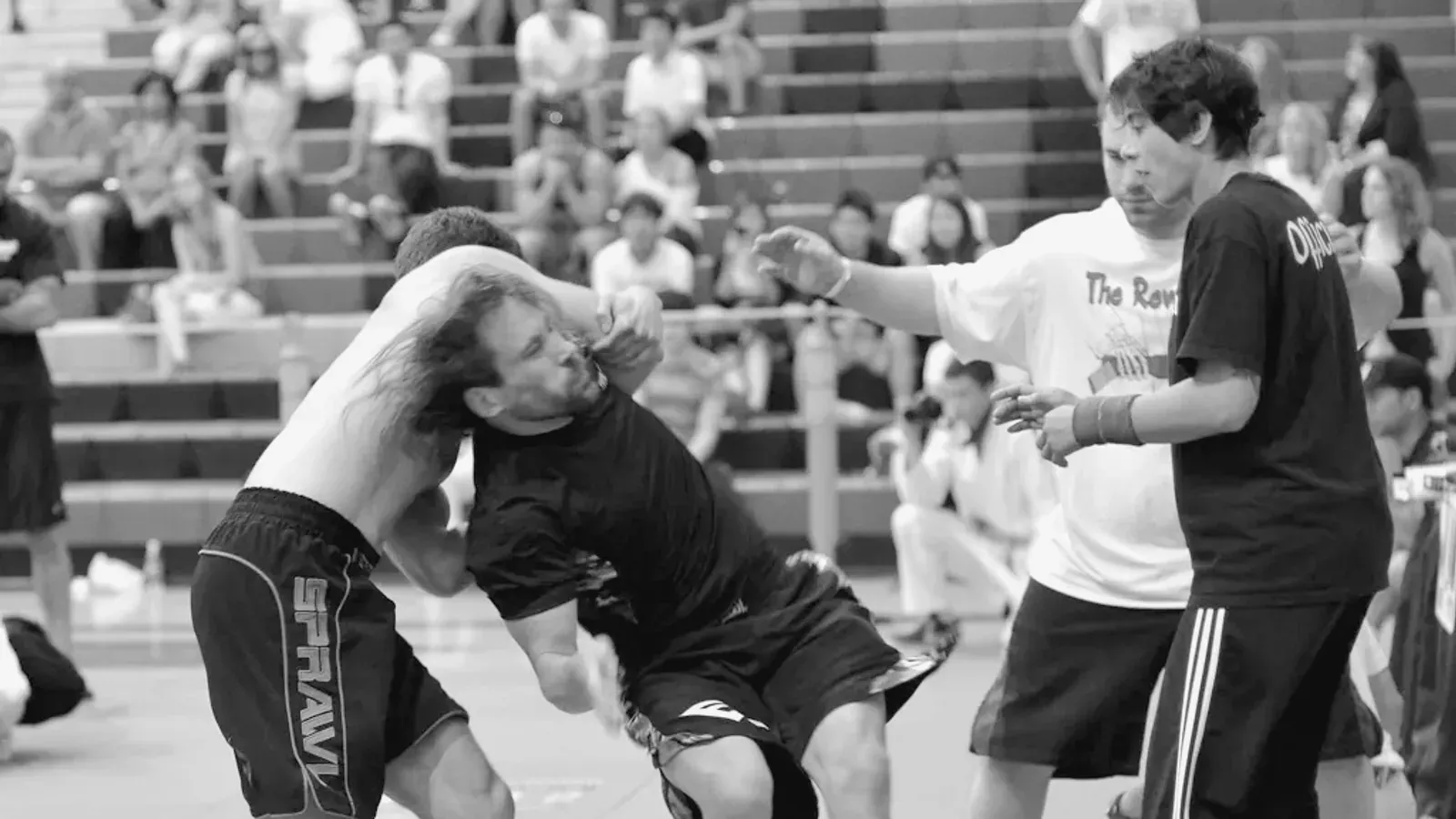
MythicSeabass · Openverse (flickr) · Creative Commons Attribution 2.0
No verified source settles this as a flat verdict. Gi and no-gi Brazilian Jiu Jitsu are both sporting formats with their own rules, not simulations of an unregulated fight, so “more realistic” needs pinning down before it can be answered properly. Ground grappling itself, the category that includes the submission holds practised in Brazilian Jiu Jitsu, is considered by some to be requisite in learning realistic unarmed combat, but that is a claim about grappling generally, not a vote for the gi or the no-gi version of it. The clearest evidence on the narrower gi-versus-no-gi question comes from how specific techniques change once the grip comes off the gi, and from how mixed martial arts, fought mostly without a gi, is still shaped by codified rules rather than being an open test of real combat.
What “realistic” actually means here
Gi refers to the padded cotton training uniform, the keikogi, that gives you a jacket and trousers to grip. No-gi strips that away, so contact is skin, rash guard or shorts rather than fabric you can grab and twist. If you’re new to how that changes a session in practice, what separates the two formats covers the basics. Which format counts as “more realistic” depends entirely on what you’re testing it against. Against an opponent in ordinary clothes, gripping fabric has an obvious equivalent. Against a fight where nobody is wearing anything to grab, no-gi is the closer match. Neither of those is settled by verified evidence; what is supported is that grappling as a category, gi or no-gi, is treated by some as necessary groundwork for realistic unarmed combat, ahead of the separate question of which grip system suits that goal better.
Grappling combined with striking, without any equivalent of a gi to grip, also has a long history. Contests resembling this kind of mixed combat go back to pankration in the ancient world, which was one of the most popular branches of ancient athletics, and comparable contests are recorded in ancient Egypt, India and Japan too. That history shows unarmed contests have run successfully both with and without an equivalent of a gi, which weakens the idea that one format has always been treated as the self-evidently realistic one.
The rear naked choke shows what changes without the gi
The rear naked choke gets its name because it does not rely on a training uniform at all. It is applied with the arms alone, around the neck, from behind, so it exists in the same basic form in gi grappling, no-gi grappling and mixed martial arts. That makes it a useful test case for whether taking the gi away actually changes anything about how a technique behaves.
It does, but for reasons that have nothing to do with clothing. The “clasping hands” version, where the supporting hand grips the choking hand rather than the opponent’s own arm, allows more pressure but loses some control of the head. That shifts the choke from a pure blood choke into more of an airway-restricting or mixed blood-and-air choke, which causes more pain but takes longer to render someone unconscious. The version used in judo, called hadaka-jime, is faster to apply and needs less strength than the version common in mixed-martial-arts competition, but it is also harder to learn. For how grip changes affect a whole session rather than one technique, how grip and pace change between the two formats goes into more detail.
The choke is also used to illustrate a difference in how realistically a technique is applied depending on the performer’s discipline: it is described as more realistically used by the professional wrestler Samoa Joe, who competes in All Elite Wrestling, because his wrestling moveset sits closer to mixed martial arts than to scripted wrestling. That comparison, closer to a discipline built around genuinely contested outcomes, is about as far as verified evidence goes toward calling one version of a technique more realistic than another, and it applies to this one choke rather than to gi or no-gi training as a whole.
What mixed martial arts’ rules show about “no rules” fighting
Mixed martial arts is fought mostly without a gi, and it is sometimes treated as the benchmark for realism because it allows striking as well as grappling. Its rules vary between organisations, though, which matters before treating it as a neutral standard. Rule sets that allow certain ground strikes are more common in Asian-based organisations than in European or American ones. Singapore-based ONE Championship, for example, allows soccer kicks and knees to the head of a grounded opponent, and elbow strikes to the head, but does not allow stamping on a downed opponent’s head. Even the foul rule runs in the injured fighter’s favour rather than the aggressor’s: if a fighter cannot continue because their opponent used a deliberate illegal technique, the opponent is disqualified. None of that is unregulated combat. It is a specific, negotiated ruleset that differs by promotion, and the presence or absence of a gi is not doing the work in any of these examples.
That also shows where gi and no-gi Brazilian Jiu Jitsu, as grappling-only sports, actually sit relative to mixed martial arts. Clinch-fighting in mixed martial arts is built around holding an opponent close enough to stop them retreating to punching or kicking range, while still attempting takedowns or throws and striking with knees, elbows and punches at the same time. Grappling, whether in a gi or without one, does not include that striking component. That gap, not the choice between gi and no-gi, is the larger difference between competitive grappling and an unarmed fight that includes strikes.
What training realism actually depends on
Within grappling-based martial arts generally, how realistic training feels is shaped more by curriculum than by whether a gi is worn. In jitsu, a related but distinct grappling art taught within the Jitsu Foundation, movement and posture are treated as the basic foundation that later, more advanced techniques are built on, a sequencing decision that has nothing to do with gi or no-gi and everything to do with how the syllabus is structured. The same organisation separates its competition format from combat itself: in competition, a competitor performs technique without the pressure of a genuinely realistic combat situation, but is still judged on control, skill and fluidity. That distinction between competing and fighting for real holds inside gi Brazilian Jiu Jitsu, no-gi Brazilian Jiu Jitsu, and, on this evidence, in other grappling arts too.
How a style handles dangerous or advanced material also varies by tradition rather than by grip system. Some organisations reserve counters to more sophisticated attacks for senior grades, while others, including traditional styles taught in Japan, work on a philosophy of immersion for all students from early on. That kind of curriculum choice affects how close training gets to realistic application far more directly than whether you are wearing a jacket to grip.
When the gi-or-no-gi question actually matters
The choice matters at the level of individual technique, where grip changes what’s available to you and how a given submission behaves once contact is skin rather than fabric, as the rear naked choke’s variations show. It does not settle the bigger question of how close grappling gets to an unarmed fight, because that gap is set mainly by the absence of striking in both formats and by how a syllabus sequences dangerous material, not by whether there is a gi to grab.